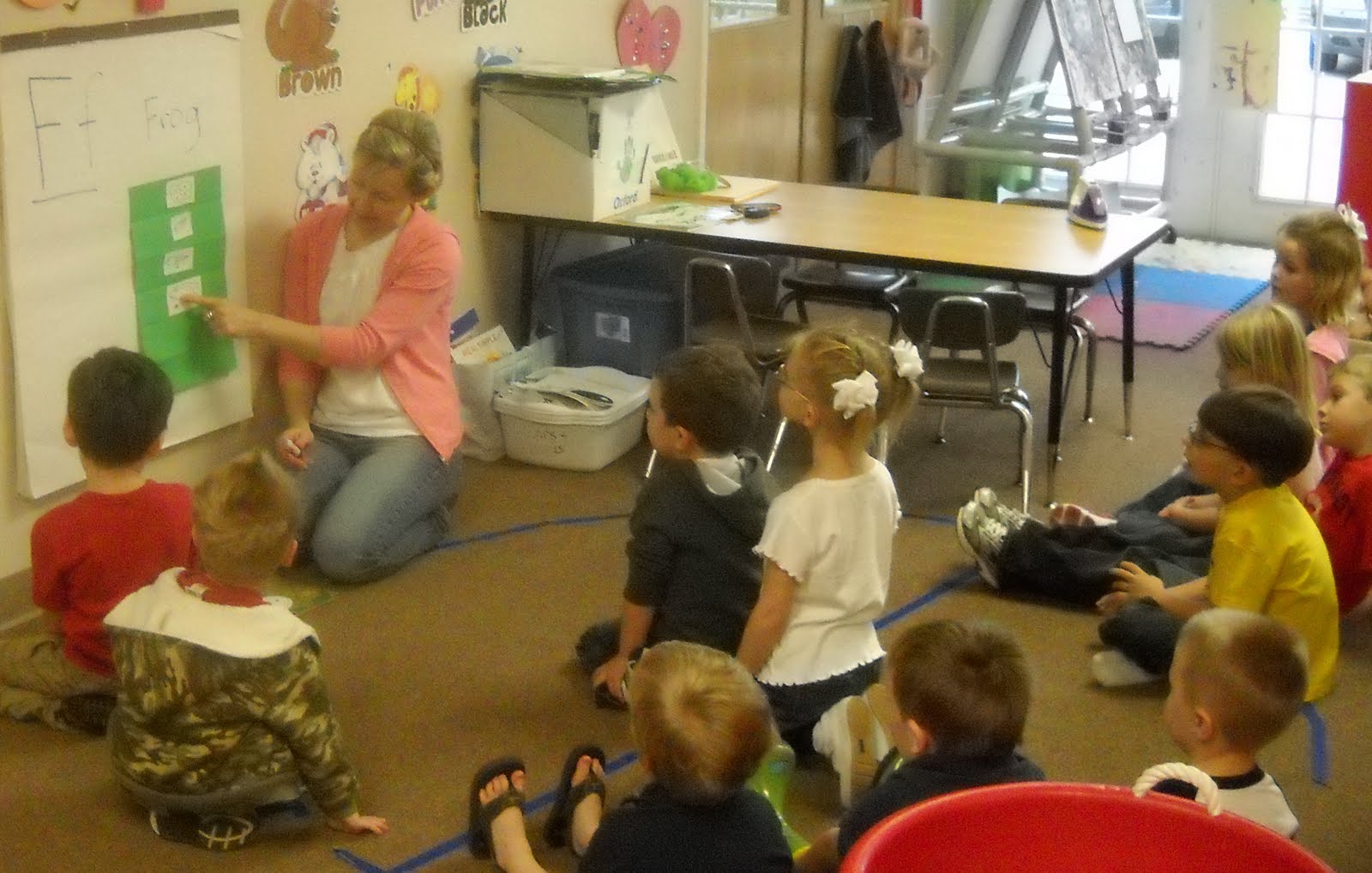
We started our investigation of Frogs with a book that clearly showed the stages of a frog's life cycle.
Then we glued the five stages from egg to frog on our paper.
We learned some new vocabulary: amphibian, tadpole, pondweed.
Frogs are born from eggs. They develop into tadpoles that have gills, then develop into frogs that have lungs.
Their tails disappear and they grow legs.
Math time had us counting out 5 green frogs and we added the speckles from the three-hole-punch.
We also sang a song about 5 Green and Speckled Frogs using our flannel board.
We counted and sang through this song several times so everyone had a turn to choose a frog from the board.
Ask your child to sing it for you. Remember to rub your tummy after "eating the most delicious bugs, yum yum!"
Easel painting gave us some large, green lily pads which we decorated with lovely pink paper blossoms.
If you have a chance, take your child to a pond to view real lily pads and if your lucky, see a frog having a rest on one!
Our writing practice focused on the letter "Ff" for Frog.
Some of us follow dotted lines, some trace over a previous drawn line, and some are independent writers. Everyone is growing and progressing.
Read-alouds are one of our favorite times of the day.
Follow along to see what we do and how we learn at Lafayette Academy Preschool in the 3's.
Working on our paper friends
Wednesday, April 27, 2011
Wednesday, April 20, 2011
Easter Eggs
Easter Eggs, baskets, bunnies, and more!
We counted paper eggs after gluing them to our baskets.
We created a ramp to race our eggs down.
Running from one end to the other, we raced eggs, cars, and anything else that would fit onto the gutter.
It was fun to guess which items would go the fastest.
We made bridges with our legs, and worked at taking turns.
The eggs moved into our kitchen area naturally. We practiced cracking them open.
Group time gave us new ways to use eggs.
We balanced them on our heads and tried holding them with with our bodies in many different ways.
Eggs filled with popcorn made great maracas for music time!

Large paper eggs were our canvas for many decorative elements.
More glue!
Making decisions about WHAT to add to our eggs and WHERE to place those pieces helps us develop critical thinking skills.
Water colors brightened our Easter Bunnies before they hopped into our school bags.
We got a jump on our gardening theme coming up in a few weeks.
Ms. Amy helped us place soil and seeds into a cup. We watered them and placed them in the window.
Now we wait.
We counted paper eggs after gluing them to our baskets.
We created a ramp to race our eggs down.
Running from one end to the other, we raced eggs, cars, and anything else that would fit onto the gutter.
It was fun to guess which items would go the fastest.
We made bridges with our legs, and worked at taking turns.
The eggs moved into our kitchen area naturally. We practiced cracking them open.
Group time gave us new ways to use eggs.
We balanced them on our heads and tried holding them with with our bodies in many different ways.
Eggs filled with popcorn made great maracas for music time!
Large paper eggs were our canvas for many decorative elements.
More glue!
Making decisions about WHAT to add to our eggs and WHERE to place those pieces helps us develop critical thinking skills.
Water colors brightened our Easter Bunnies before they hopped into our school bags.
We got a jump on our gardening theme coming up in a few weeks.
Ms. Amy helped us place soil and seeds into a cup. We watered them and placed them in the window.
Now we wait.
Wednesday, April 13, 2011
Birds
The subject of Birds was deep and wide.
With only one week, we barely skimmed the surface of this amazing group of animals.
Our group times focused on some factual information about all birds: they have feathers, wings, and a beak.
We used our magnifying glasses to take a look at some real bird feathers. Did you know that birds have three different types of feathers on their bodies?
Using that knowledge, we created birds cut from our easel paintings and added a beak, wings, and feathers.
We talked about WHY a bird builds a nest and WHAT a nest is made of.
Using some art supplies, we created our own version of a nest and filled it with Hummingbird eggs.
We practiced the letter "Bb" which begins the word "Bird".
Our writing skills have truly improved over the course of our school year thanks to our brave "risk-takers".
Music time is a favorite no matter what subject we are learning about. This weeks song was "Five Little Ducks". Everyone sang, performed the hand motions and laughed when the Daddy Duck called his ducklings home.
With only one week, we barely skimmed the surface of this amazing group of animals.
Our group times focused on some factual information about all birds: they have feathers, wings, and a beak.
We used our magnifying glasses to take a look at some real bird feathers. Did you know that birds have three different types of feathers on their bodies?
Using that knowledge, we created birds cut from our easel paintings and added a beak, wings, and feathers.
One of the most interesting birds is the Hummingbird. It's tiny eggs are the size of jelly beans!
We looked at some and compared them with the egg of a chicken and an ostrich.
Then we ate them! (the jellybeans)
We talked about WHY a bird builds a nest and WHAT a nest is made of.
Using some art supplies, we created our own version of a nest and filled it with Hummingbird eggs.
We practiced the letter "Bb" which begins the word "Bird".
Our writing skills have truly improved over the course of our school year thanks to our brave "risk-takers".
Music time is a favorite no matter what subject we are learning about. This weeks song was "Five Little Ducks". Everyone sang, performed the hand motions and laughed when the Daddy Duck called his ducklings home.
Wednesday, April 6, 2011
Continuing our look at BUGS, we devoted ourselves to caterpillars and butterflies this week.
We used our new paint dabbers to create colorful caterpillars with many body segments.
At group time, we read some great stories about the amazing change that happens to caterpillars.
We also learned a new vocabulary word for this event: metamorphosis.
We practiced drawing the letter "Cc" for Caterpiller and "Bb" for Butterfly.
Using beads and plastic lacing, we created "caterpillar" necklaces, with the beads representing the body segments.
It was tricky work to keep those beads from sliding back off sometimes, but the end result was lovely!
Look at that LONG "caterpillar" necklace! That is a lot of work.
Moving onto Butterflies, we used water color paint and coffee filters to create their delicate wings.
We created sets of symmetrical wings with paint after cutting out a large "B" shape.
The books that line our shelves are full of great illustrations and facts that help us to understand these wonderful creatures.
Check out our book list on this blog!
We used our new paint dabbers to create colorful caterpillars with many body segments.
At group time, we read some great stories about the amazing change that happens to caterpillars.
We also learned a new vocabulary word for this event: metamorphosis.
We practiced drawing the letter "Cc" for Caterpiller and "Bb" for Butterfly.
Using beads and plastic lacing, we created "caterpillar" necklaces, with the beads representing the body segments.
It was tricky work to keep those beads from sliding back off sometimes, but the end result was lovely!
Look at that LONG "caterpillar" necklace! That is a lot of work.
Moving onto Butterflies, we used water color paint and coffee filters to create their delicate wings.
We created sets of symmetrical wings with paint after cutting out a large "B" shape.
The books that line our shelves are full of great illustrations and facts that help us to understand these wonderful creatures.
Check out our book list on this blog!
Thursday, March 31, 2011
Insects
We filled a tub with dry rice and lots of rubber insects.
Using our eyes and our hands, we tried to match pairs of insects.
We found ants, grasshoppers, ladybugs, and beetles.

Using books and larger than life models of bugs, we learned that insects have six legs, three body parts, and a pair of antennae.
Circles are the shape of a ladybug and our new paint dabbers were just perfect for making ladybug spots.
We used a LOT of glue to add tiny eyes and antennae to our bugs.
Can you count all the spots on the ladybug you made?
We counted and sang "The Ants Go Marching" at group time.
Cutting the rounded shapes of bugs at the writing center was a challenge.
Matching pairs of insects had us making decisions and carefully drawing lines to connect the two.
Our cooking activity was a baking project: Biscuit Bugs
We rolled out dough and cut three small circular shapes for our three body parts.
Carefully placing them together, we watched them bake and ate them up at snack time.
Tasty bugs!
Using our eyes and our hands, we tried to match pairs of insects.
We found ants, grasshoppers, ladybugs, and beetles.

Using books and larger than life models of bugs, we learned that insects have six legs, three body parts, and a pair of antennae.
Circles are the shape of a ladybug and our new paint dabbers were just perfect for making ladybug spots.
We used a LOT of glue to add tiny eyes and antennae to our bugs.
Can you count all the spots on the ladybug you made?
We counted and sang "The Ants Go Marching" at group time.
Cutting the rounded shapes of bugs at the writing center was a challenge.
Matching pairs of insects had us making decisions and carefully drawing lines to connect the two.
Our cooking activity was a baking project: Biscuit Bugs
We rolled out dough and cut three small circular shapes for our three body parts.
Carefully placing them together, we watched them bake and ate them up at snack time.
Tasty bugs!
Subscribe to:
Posts (Atom)